
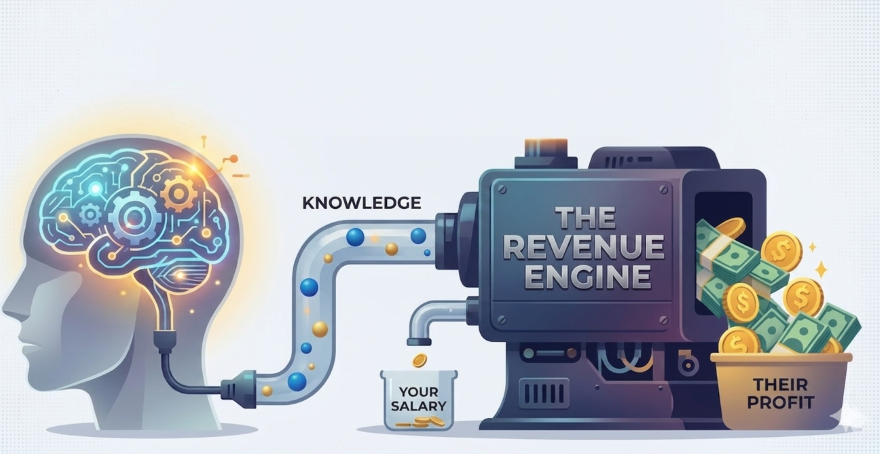
Every month you clock in, someone else is selling what’s inside your head and keeping all the money.
Let’s do the math nobody at your workplace will do for you.
Take your monthly salary. Multiply it by 12. That’s what your employer pays you in a full year to access your brain, your skills, your problem-solving, your time, and your energy — every working day, including the days you’re exhausted, the days your family needed you, the days you pushed through anyway.
Now sit with that number.
Because somewhere on the internet right now, someone with a fraction of your knowledge packaged what they know into a PDF, a course, or a private community — and made that same number. Not in a year. In a month. Some in a week. A few in a single day.
Same knowledge economy. Completely different position in it.
One person rents their knowledge by the hour. The other sells it at scale, while sleeping, while traveling, while doing something else entirely.
You are almost certainly in the first group. This article is about crossing over.
The Salary Was Never Designed to Make You Wealthy
This is uncomfortable but necessary.
A salary is not a reward for your value. It is the minimum amount your employer calculated they could pay you to keep you from leaving — while they extract significantly more value from your presence than they return to you.
That’s not cynicism. That’s the structure.
Your employer sells your output — your ideas, your service, your execution — to customers at a price far above what they pay you for it. The gap between what you’re paid and what your work generates is called profit. And your employer keeps it.
You knew this. Somewhere in the back of your mind, you always knew this.
What you perhaps didn’t fully see is that the same knowledge your employer monetizes on your behalf — you could monetize yourself. Directly. Without the middleman. Without the permission. Without the annual review where they offer you 8% and call it a raise.
The knowledge economy changed the rules. And most salaried workers haven’t noticed yet.
What “Packaged Knowledge” Actually Means in Money Terms Let’s stop being abstract.
A nurse in the UK who spent years learning how to navigate the NHS, manage night shifts without burning out, and pass professional licensing exams — she packaged that into a private community and a short course for Nigerian nurses preparing to relocate. She charges £25 a month for the community. She has 340 members.
That’s £8,500 a month. From knowledge she already had. From experience she was going to have anyway.
Her NHS salary — respectable by most standards — takes twelve months to produce what her community generates in five weeks.
A secondary school teacher in Lagos who spent fifteen years teaching mathematics decided to record his explanations of WAEC past questions. Sixty short videos. Clean, clear, no studio — just a whiteboard and his phone. He uploaded them as a course on Selar for ₦4,500.
In the first three months, 1,800 students bought it.
₦8,100,000. In three months. From one course. Recorded once.
His teaching salary for the same period: ₦540,000.
Same knowledge. One version rented by the hour to a school. The other sold at scale to anyone with a phone and a WAEC exam coming up.
A financial analyst in Lagos who understood how to read stocks and build a personal investment portfolio — not professionally, just for himself — started a Telegram channel. Shared what he was learning. Grew an audience. Then launched a four-week cohort: “How to Start Investing in Nigerian Stocks With ₦50,000 or Less.” Charged ₦25,000 per seat. Capped it at 80 students.
₦2,000,000 in one cohort. In four weeks. His monthly salary at the time: ₦380,000.
These are not exceptional people. They are people who made one decision differently from everyone else around them.
The Exact Moment the Salary Becomes a Trap
It doesn’t feel like a trap at first. It feels like stability.
And stability is real. A salary pays rent. It feeds children. It keeps the lights on. Nobody is saying burn it down.
But stability and a ceiling are not the same thing. And a salary, if you’re not careful, quietly becomes both.
Here’s how the trap closes:
You get the job. You get used to the income. Your expenses rise to meet it — rent, lifestyle, obligations. Now the salary isn’t just income. It’s a lifeline you can’t afford to lose.
So you stay. Even when the job stops growing you. Even when you know more than your manager. Even when you’re doing work that, packaged differently, would be worth five times what they pay you. You stay because leaving feels like falling.
That fear — that specific fear of losing the monthly guarantee — is the trap. Not the salary itself. The dependency on it.
And the only way out is to build something that pays you separately. Something that doesn’t care whether you’re employed or not. Something that earns while you’re still at the job — until the day you decide you don’t need the job the way you used to.
That something is packaged knowledge.
Why Knowledge Scales in a Way Your Salary Never Will
When you sell your time, there’s a hard ceiling.
There are only 24 hours in a day. Even if your employer doubles your salary, you still can’t work more than those hours. Your income is capped by biology.
Knowledge packaged into a product has no such ceiling.
You build it once. Then it sells to one person. Then ten. Then a hundred. Then a thousand. You don’t do more work each time it sells. The PDF doesn’t get tired. The course doesn’t need to sleep. The template doesn’t take maternity leave.
This is the fundamental difference between earned income and what some people call passive income — though “passive” is slightly misleading because building the product takes real work upfront. But once built, the leverage is unlike anything a salary can offer.
A salary gives you a 1:1 ratio. One hour of work, one hour of pay.
A digital product gives you a 1:many ratio. One hour of creation, potentially thousands of hours worth of sales.
One year of salary for one month of sales is not a fantasy. It is basic math applied to the right model.
The Products That Move Fastest and Earn the Most
Not all digital products are equal. Some sell slowly. Some sell once and stop. Some, built right and priced right, create income streams that outlast the trend that started them.
Here’s what moves:
Certification and exam prep. IELTS. PMP. ACCA. JAMB. WAEC. ICAN. Any exam with a large, desperate, recurring pool of candidates. People preparing for these exams will pay serious money for clear, focused help. The audience never runs out because new candidates appear every cycle.
Relocation and visa guides. Canada. UK. Germany. Portugal. Australia. Every country with an active immigration route has thousands of people trying to navigate it monthly. Someone who has done it and documented it clearly is sitting on a product that sells itself.
Professional skill translation. You know how to do something technical — Excel modeling, legal drafting, project scheduling, medical billing, grant writing — and most people in your field just do it without ever teaching it. Package the skill. Sell it to people trying to enter your field or improve in it.
Income and money management for specific audiences. Not general finance. Specific. “How to invest on a corper’s allowance.” “Building savings as a market trader.” “Understanding your pension as a Nigerian civil servant.” Specific beats general every single time.
Trade and craft skills. Tailoring patterns. Cake decorating. Tile setting. Plumbing basics. Electrical fundamentals for homeowners. These feel unglamorous until you see the sales numbers. Millions of people want to learn practical things and have nowhere obvious to start.
The insider guide. You work in an industry. You know how it actually works — not the public-facing version, the real version. How contracts are awarded. How suppliers get approved. How the hiring really works. How to navigate the system. That insider knowledge, packaged carefully and legally, is among the most valuable things you can sell.
The Comparison That Should Keep You Awake Tonight
Imagine two colleagues. Same department. Same qualification. Same salary. Started the same year.
Colleague A goes home every evening, watches TV, complains about the economy, and waits for the next salary review.
Colleague B goes home, spends 90 minutes three times a week turning their work knowledge into a structured online course. Takes four months to build it properly. Launches it quietly. Prices it at ₦15,000.
In year one, Colleague B sells 200 copies. ₦3,000,000. Outside their salary. No tax deducted at source. No boss approving it. No HR involved.
Year two, they improve the course, add a community, raise the price to ₦22,000. Sell 350 copies. ₦7,700,000.
By year three, Colleague B’s course income alone exceeds their annual salary. The salary becomes optional. The fear goes away. The trap opens.
Colleague A just got a 10% annual raise.
Same starting point. Completely different outcome. The only variable was what they did with the 90 minutes.
What Your Employer Knows That You Don’t
Here’s the thing your company understands very clearly and prefers you don’t think about too hard:
Your knowledge, properly packaged, is worth far more than your contract says.
Companies pay for training. They build internal knowledge bases. They pay consultants to teach their staff things their own staff already knows but hasn’t been asked to formalize. They pay coaches, facilitators, and content developers to package institutional knowledge into learnable formats.
All of that is work you could do for yourself.
The moment you package your own knowledge, you stop being just an employee and start being something else — a content business, a knowledge brand, a one-person education company.
That shift doesn’t require you to quit. It doesn’t require startup capital. It doesn’t require a business partner or a physical location or government approval.
It requires a topic, a product, a price, and a platform.
You have the topic. The product takes weeks to build, not years. The price you decide. The platform is free.
One Year’s Salary. One Month. Here’s the Honest Version
Making a year’s salary in one month is possible. It happens. But let’s be honest about when and how.
It doesn’t happen on day one. It doesn’t happen with a rushed product and no audience.
It happens when:
You’ve built something genuinely useful. Not copied, not thin — something that actually solves a real problem for a specific person.
You’ve grown an audience, even a small one. Two hundred engaged people who trust you will generate more sales than two thousand strangers who stumbled on your link.
You launch with intention. A proper launch — building anticipation, clear messaging, a deadline — outperforms quietly posting a link and hoping.
Some people hit this in month six. Some in month eighteen. A few in month three because they had an existing audience and launched into it.
The timeline varies. The math doesn’t.
One course. One hundred buyers. ₦50,000 price point.
₦5,000,000. In one launch window.
The average Lagos professional’s annual salary. Earned in a week of active selling.
That’s not a fantasy. That’s a price point multiplied by a realistic buyer number. The only question is whether you’ll build the thing or not.
The First Move
Not the whole strategy. Just the first move.
Today, write down the single most valuable thing you know how to do professionally. The thing you’d be called into a meeting to explain. The thing junior colleagues ask you about. The thing you do almost automatically that others find complicated.
Write it in one sentence: “I know how to ____________ for ____________ people.”
That sentence is the seed of a product that could, built right and sold right, match or exceed what your employer pays you in a year.
Your salary is not your ceiling. It never was.
It was just the first offer on the table. And you took it because nobody showed you there were others.
Now you know.
You have been trading your most valuable asset — knowledge — for the most limited possible return. A salary. It’s not too late to renegotiate. Not with your employer. With the market.